

ADHD meal planning works best as a short loop: five to seven dinners you already like, repeated every week, plus three emergency defaults for the nights nothing sounds good. You make the food decisions once a week, in the hour your brain has the most left, and every other evening you pick from a list that is already written.
We learned that the long way. The ADHD Weasel started with two international students in Canada throwing out too much food, and a food-waste app that grew into FeedMyADHD, a meal planner built for ADHD brains. Along the way we talked to more than 250 ADHDers about food, and more than 3,000 people tried an early website version. We retired the app in July 2025. What those people told us is on this page, and none of it needs an app.
Why meal planning is so hard with ADHD
A dinner is a chain of small decisions: what to eat, whether you have it, when to start, and whether there is any energy left to cook it. Each link costs something, and by 6:40pm on a Wednesday the budget is gone. That is when the takeout app opens for the third night in a row, and the vegetables you bought on Sunday start their slow slide to the back of the crisper.
The people we talked to named the same few walls. Endless options froze them at the recipe stage, so they picked nothing, or picked the easiest thing and felt bad about it. A software engineer who tried our early version told us: “I usually spend hours scouring recipe blogs and end up with nothing.”
Food they could not see stopped existing, and appetite kept its own hours. Stella, a reader, wrote under our first food issue: “i only think about food when i am STARVING. if i’m not feeling faint from hunger, i forget food exists.” Stimulant medication can blunt hunger too, and a long stretch of focus can hide it until anything with sugar in it looks like dinner.
Under all of it sat guilt, for the takeout and for the groceries that spoiled in the crisper. The plans people kept were loose ones, held as suggestions, which is why everything below is short.
Most meal-planning advice asks for seven different dinners a week, which is seven fresh decisions on seven tired evenings.
The meal loop: five to seven dinners on repeat
Write down five to seven meals you have made before and liked, with few steps and ingredients you can find. If you cook for other people, pick meals they eat without a negotiation. Put the list where you will see it at 6pm, on the fridge door or the first screen of your phone. When it is time for dinner, you pick one from the loop.
The grocery list stops changing too, because the meals stop changing. Shopping becomes the same list most weeks, and the crisper holds what you cook.
Three emergency defaults
Some nights even the loop is too much. Keep three defaults that take under five minutes and need no decision, like eggs on toast, a frozen burrito, or cereal with fruit after it. Write them at the bottom of the loop list, so the choice on a bad night is between three things you already own, and the guilt has nothing to hold on to.
One decision day
Pick the hour of the week when your brain has the most left, for many people Sunday morning, and make the food decisions there: which loop meals this week, what to buy, and which night is takeout on purpose. Every weekday evening after that is a pick from a list you already wrote.
Keep food where you can see it
Our research confirmed what you probably know already: the leftovers vanish the moment the fridge door closes. Clear containers, leftovers at eye level, and this week’s vegetables on the top shelf where the door opens. What you can see at 6pm is what gets cooked.
When nothing sounds good
Narrow it to two options, give each one a side of a coin, and flip. Notice what you feel when it lands. A flicker of disappointment means you wanted the other one. If you feel nothing, either is fine, and the coin decided. We first wrote this up as the rule of two for restaurant menus, and it works the same way at the fridge.
More on food and ADHD
Food choices and ADHD: the daily struggle of feeding yourself, from our first round of food research
Why you start the day unstoppable and end it unable to pick dinner
Make meals easier with ADHD: five tiny fixes, from nutrition educator Annika Angelo
Your ADHD and food questions, answered, by chef Catherine Smart
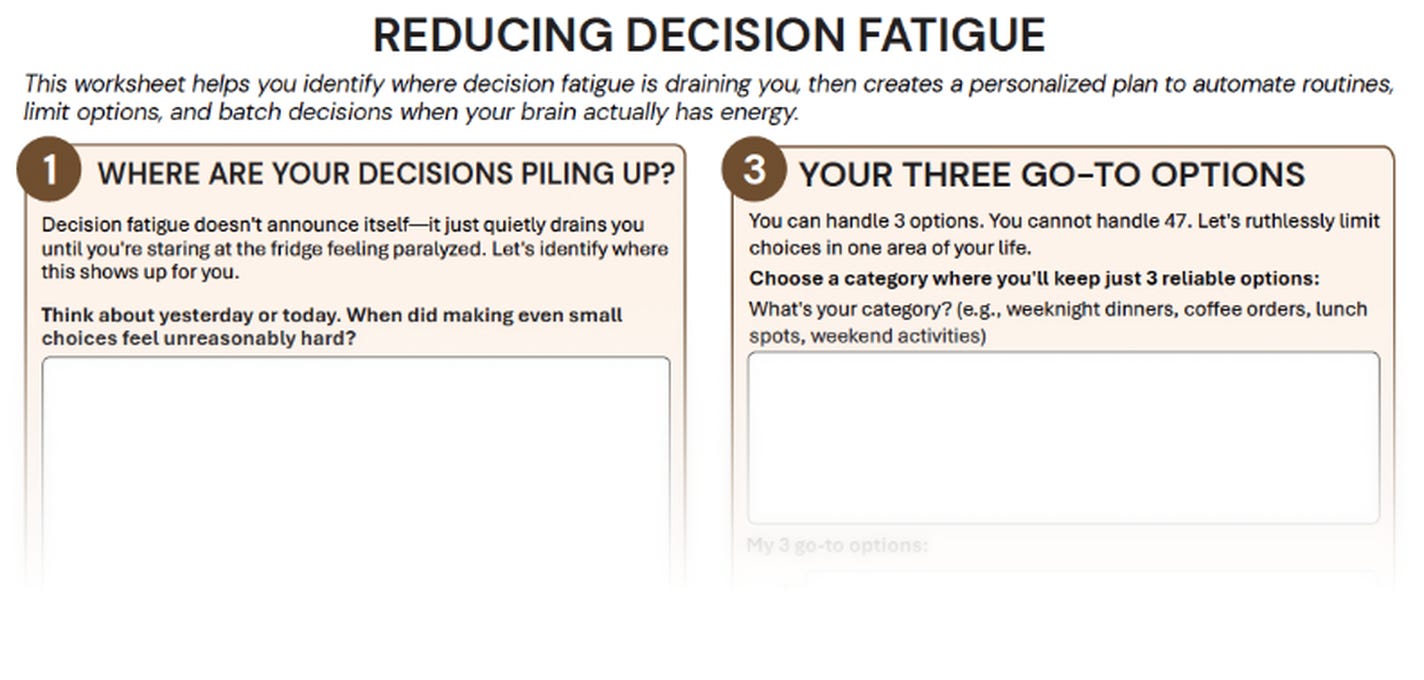
The worksheet below takes one recurring food decision off your plate this week: three go-to dinners for one category, one thing to automate, and a weekly batch-decision time. If you see a Claim my free post button below, Substack will unlock it for you free in its app, one post per reader. Paid subscribers get every new worksheet.
The rest of this issue is for members: what the research says is going on, and what to do with it this week. Membership opens every Wednesday and Saturday issue in full, every worksheet since April 2025, and the archive back to February 2025: Become a member.