Their Mess Takes 20 Minutes. Yours Has Been There Since Friday.
Your brain treats other people's messes like a fresh start. Yours carries every decision you've already failed to make.
You’re at a friend’s house after dinner. There are dishes in the sink, sauce dried on the stove, a cutting board still out on the counter. You grab the sponge and start scrubbing. Twenty minutes later, the kitchen looks brand new.
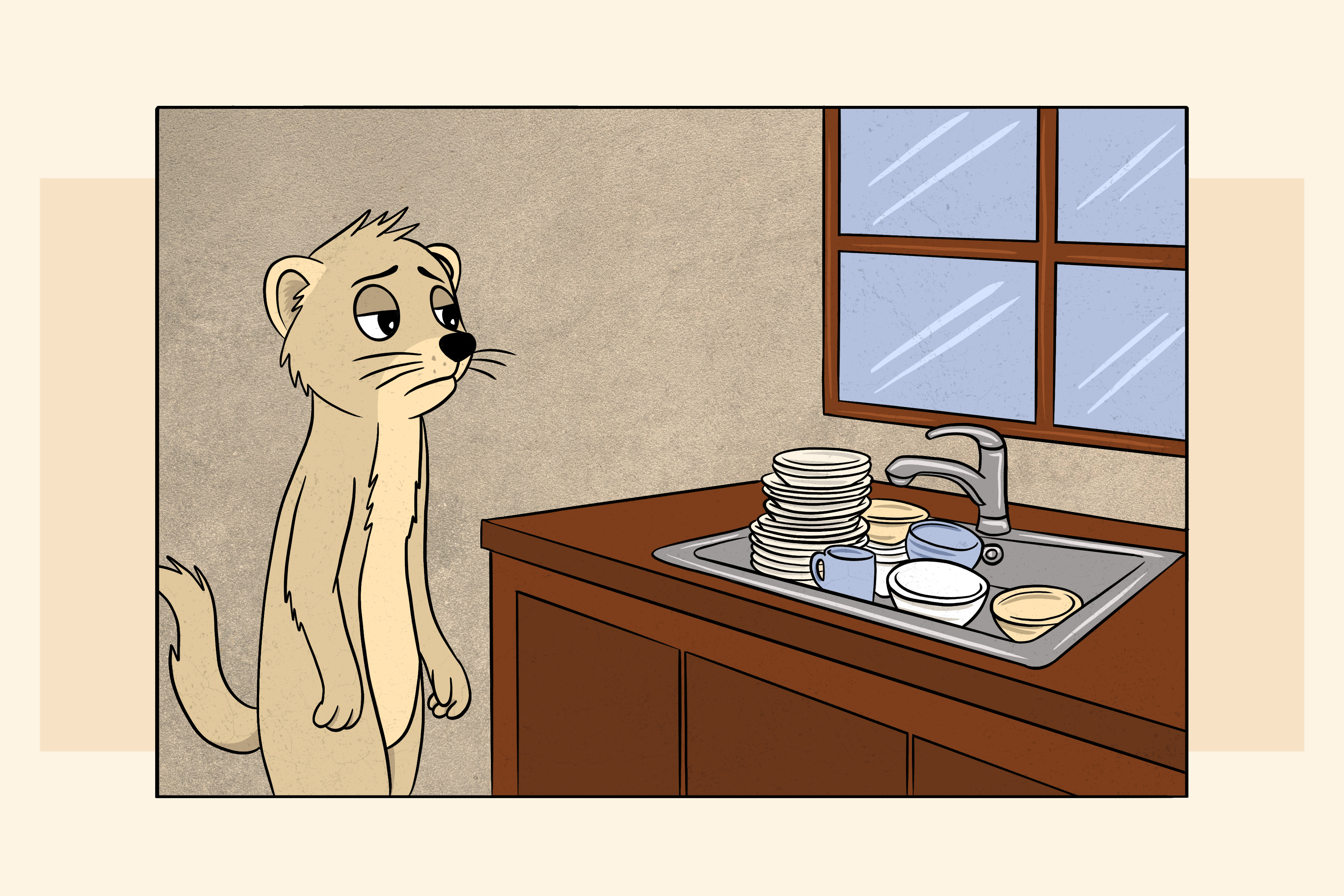
Your own kitchen has looked like a crime scene since Tuesday. You’ve walked past those dishes nine times today.
At the end of this newsletter, there’s a 5-minute worksheet called What Your Mess Is Really Carrying that helps you see what’s actually weighing down your own space and change the conditions around it.
Why their kitchen is easier than yours
Your friend’s kitchen is a clean problem. Not clean as in tidy. Clean as in uncomplicated. There are dishes. They need washing. Done. Your kitchen carries weight. The slow cooker from the meal prep phase, the mail you haven’t opened, the mugs that remind you the dishwasher still needs emptying from two days ago.
A new environment is the only stimulant our brains get for free. Different layout, different tools, no history. Our brains get a dopamine bump from the unfamiliarity alone, and every decision that requires executive control costs us more than it costs a neurotypical brain. In someone else’s kitchen, there are none of those decisions.
Someone else’s mess doesn’t carry your shame.
Each time you walk past something undone, a layer of guilt deposits on top of it. Walk past it enough times and the task isn’t “wash the dishes” anymore, it’s “face the fact that you still haven’t washed the dishes.” The object becomes evidence. Household chores are the most avoided daily tasks for adults with ADHD. At your friend’s house, their dishes are just dishes.
Cleaning someone else’s kitchen comes with built-in company. When another person is present, our performance goes up on straightforward tasks. This is why body doubling works. At home, with no one watching, all motivation comes from inside, and for our brains, that’s the weakest fuel source we have.
(We dug into why external accountability changes everything for ADHD brains in How to Get Things Done When Your Brain Won’t Hold You Accountable.)
Your brain gets novelty, zero shame, and an audience all at once. At home, none of those exist. Context is everything!
From our readers
“I am a clinical psychologist who works in ADHD and Autism. I find your tips some of the most concise, palatable, and actionable ones available, and they work, for me and my clients!”
- Kat, paid subscriber
Things to try
Each strategy is tagged by energy level: 🥄 low, 🥄🥄 medium, 🥄🥄🥄 high. Pick the one that matches your brain today.
1. The “someone’s coming over” trick 🥄
Set a 20-minute timer and pretend a friend just texted that they’re on their way. Don’t clean your whole house. Just the room they’d see.
This works because it manufactures three things your brain needs: a deadline, an audience, and a limited scope. You’re not “cleaning the kitchen.” You’re making one room look passable before a person arrives. The pretend accountability activates the same pathway as the real thing. Your brain doesn’t know the difference.
2. Borrow someone’s eyes 🥄🥄
Call a friend, put them on speaker, and clean while you talk. Or use a body doubling app or video call with someone doing their own tasks. The point is another human existing in your awareness while you work.
Body doubling, completing a task with someone else present, is one of the most reported facilitators for adults with ADHD. You don’t need them to help. You don’t need them to watch. You just need them to be there.
3. Trade messes with someone 🥄🥄🥄
Find a friend, neighbor, or family member and swap. You clean their kitchen. They clean yours. Or go together and do one space, then the other.
This is the full reset: their space gives you novelty and zero shame. Your space gets cleaned by someone who doesn’t carry the emotional history of every mug and mail pile. Both of you benefit from the paradox instead of fighting it.
This week’s Apply It worksheet
This worksheet helps you see what's actually weighing down the space you keep walking past, name the shame layers and decision pileups making it impossible, and change the conditions around it this week.
Partner perspective
If your partner doesn’t understand why you scrubbed your coworker’s garage last weekend but haven’t touched the hall closet in six months: novel spaces carry no shame history, no decision weight, and a built-in audience. Home has all three working against an ADHD brain. Changing the conditions around the task does more than willpower ever could.
💬 Discussion prompt
What’s the one space in your home that carries the most shame weight for you. The room or corner or drawer you avoid even looking at because of what it represents.
Thanks Ellie for last week's comment. Each week, one comment wins a $25 USD Amazon gift card.
How did you enjoy our newsletter today?
If this read helped you, pass it on: a like, comment, restack, or share helps more ADHDers feel understood and less alone :)


My laundry...let's call it a pile.. I just *love* having to mess with it each morning to get ready for work and starting my day with an XL dose of "I should"🙄
Paperwork for me . As soon as I toss it turns out I need it again. Or I put it in a pile to scan, which stacks up faster than I can get to it so another pile. Lots of filing boxes & working on a system to Simplify but its a constant battle. Just cleaned out parents home & will need shredder for tons of papers with bank & Ss numbers of many living family. Digital is also going to need some work but I am now spending time I dont have eliminating email I didnt ask for from 6 different email addresses. Thats why I feel certain online platforms are a menace as they just bomb with email. Its all so much time & tiring. How do people do it??