

Most of what we hear about exercise is about later: your heart in twenty years, your blood pressure, the decades you'd like to stay healthy for. All true, and all of it years away, which is the distance this brain struggles most to feel on an ordinary afternoon.
There's a shorter story that gets told less often. Thirty minutes of movement changes how a brain works the same day, for up to two hours afterward, and in adults with ADHD the change shows up on the thing that's usually hardest: staying with a task.
That shorter story is what this issue is about. We'll walk through what happens in a brain in the hours after you move, why ADHD brains seem to get more out of it, and three ways to put that window where your day needs it. Whether you walk every morning, stopped a while back, or haven't started, the window works the same way, so the strategies come in sizes.
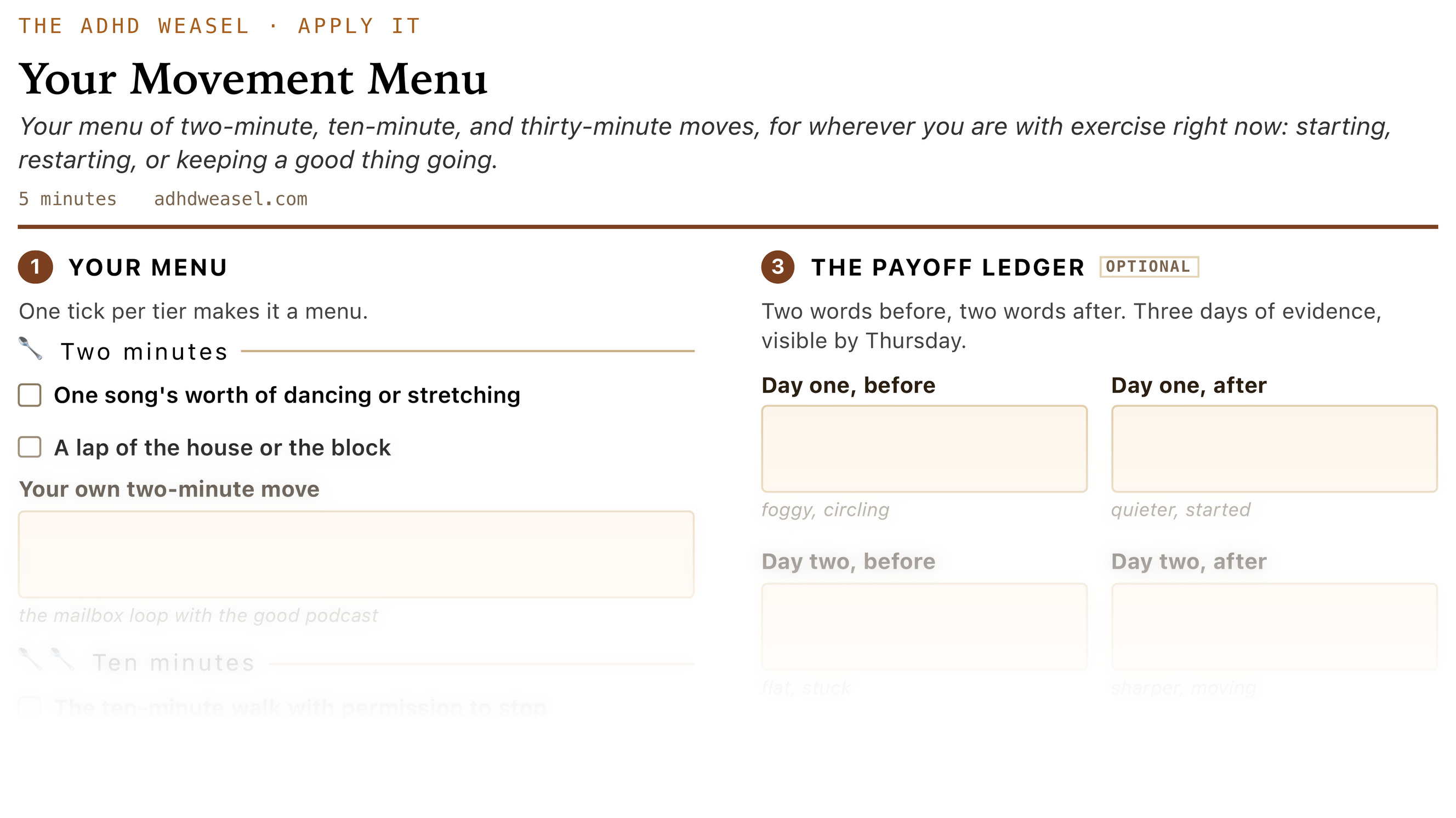
There's a 5-minute worksheet at the end of this newsletter called Your Movement Menu. Wherever you are with exercise, it builds your menu of two-minute, ten-minute, and thirty-minute moves, and it's free for everyone today, like this whole issue.
What happens in the two hours after you move
Start with what one workout does in any brain. A review of single-session exercise research found that one bout lifts mood, softens the body's response to stress, and sharpens the focus skills that live in the front of the brain: attention, working memory, holding back an impulse. Those effects last up to two hours after you stop moving.
The effect gets more interesting in an ADHD brain. In a study of adults with ADHD, thirty minutes of moderate cycling measurably sharpened attention and speed on a focus task in the same session, right after the ride. The people without ADHD in the study did the same ride and got no faster on that task.
A companion study showed the exercise effect ran strongest in the adults who found the task hardest, and the broader evidence keeps pointing the same way: movement raises dopamine and norepinephrine, the same two signals that stimulant medications, the most common ADHD treatment, boost to help attention.
That overlap is the researchers’ best explanation for why a workout lands harder on an ADHD brain. In these studies, the effect showed up in brains like ours, and it was biggest in the people struggling most.
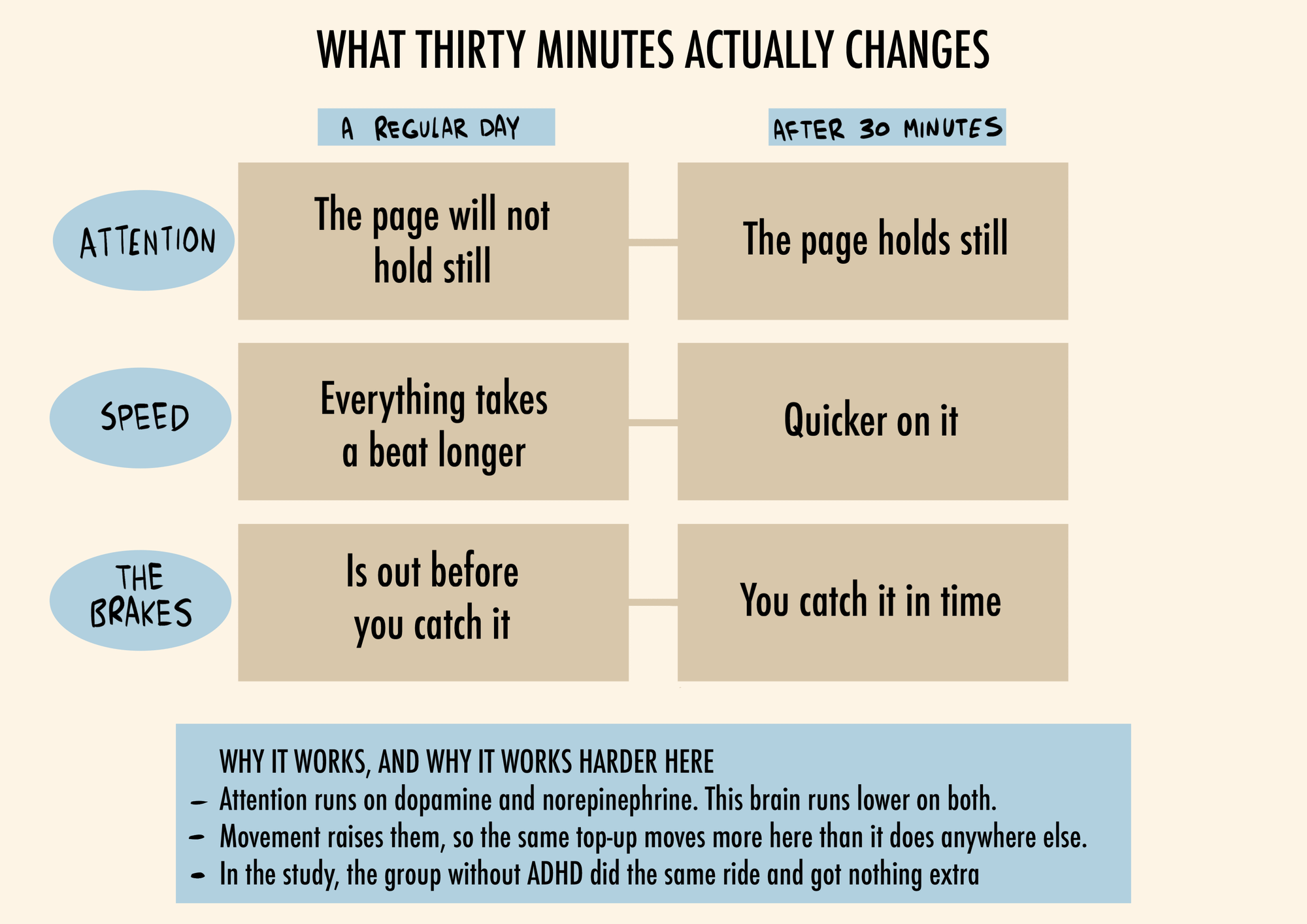
Thirty minutes of movement buys you up to two hours of sharper focus today. The payoff lands this afternoon, exactly where your day hurts, and it works the same whether you move every day or haven't in a year.
One more honest thing before the strategies. If your body has limits, pain, an injury, joints with opinions, every dose below bends to what your body allows, and the bendable version counts in full. Nobody is checking your form.
Things to try
🥄 Shrink the dose until it fits in a gap
The two-minute versions count, because they are the ones that still happen on a bad day, and they keep the door open for the longer doses. Pick moves that hide inside your existing day:
One song's worth of dancing or stretching
A lap of the house or the block between two things you're doing
The mailbox loop with the one podcast you only let yourself play while walking
That last one is the trick to steal: pair the movement with something you already want, and let the wanting get you started.
🥄🥄 Sign the ten-minute contract
For the consistency problem, at any point on the spectrum. Ten minutes, with permission to stop at ten, written down, so the negotiation is over before it starts. Most days you'll keep going, because stopping mid-motion is its own transition and transitions are expensive. On the days you stop at ten, the contract was honored and tomorrow owes you nothing.
🥄🥄🥄 Spend the payoff on purpose
This one is for everybody, and especially for you if you're already moving. Look at tomorrow and find the part you're dreading. Put your movement directly before it. Now the sharp window lands on the exact hours that need the help. Tie it to something that already happens every day, your first coffee, lunch, the evening news, so it starts when that does.
This week's Apply It worksheet
By the end of the worksheet you'll have your own menu: two-minute, ten-minute, and thirty-minute doses built from things you don't hate, a pairing for each one, and a three-day payoff ledger so you can watch the focus window show up in your own handwriting.
Movement looks different for everyone, so the last section is optional and built to bend: it turns your answers into a prompt for the AI tool of your choice, and that tool drafts a one-week plan that starts where you are. Treat that plan as a starting point and change anything that doesn't fit. Free for everyone today. Takes 5 minutes.
The takeaway for the week
In those cycling studies, the people without ADHD got no faster from the ride, and the boost was biggest for the adults with ADHD who found the task hardest. For once, in these studies, a tool worked better on our brains than on everyone else's, and it worked best exactly where it was hardest.
If there's a drawer of hopeful gear somewhere in your house, it says nothing about your discipline. It was bought for a payoff years away, and this brain was never going to show up for that one. The payoff that works on us lands this afternoon, so start there. And if the moving never stopped, take the third strategy and spend tomorrow's sharp window on purpose.
How did you enjoy our newsletter today?
If this read helped you, pass it on: a like, comment, restack, or share helps more ADHDers feel understood and less alone :)