

You need to leave for the office in 10 minutes. You know this. The time is right there on your home computer screen. You checked your phone while getting ready, saw one email you could quickly respond to, and sat down at your desk for "just a minute" before heading out the door. But now you're mid-sentence, and your fingers won't stop typing.
Your brain keeps whispering "just one more line, almost done." Forty-five minutes later, you're still at your home desk, that email somehow turned into a rabbit hole, and you're now arriving to the office an hour late on the first week back, exactly the opposite of the fresh start you wanted.

The frustration you feel when you can’t make yourself stop one thing and start another is completely valid. Our brains have difficulty disengaging from the current task and redirecting toward the next one. The inertia you feel is real, and has nothing to do with how hard you’re trying. This week’s Apply It worksheet walks you through building your personal transition plan before you need it.
What makes transitions so hard
Your brain isn’t just “having trouble switching.” It’s paying a neurological toll every time you change tasks. Cognitive scientists call this the switch cost, and decades of research confirm it’s significantly higher in ADHD brains.
When you’re doing a task, your brain creates a “task-set” with the rules, attention patterns, and responses needed for that activity. Switching to a new task requires inhibiting that old task-set while activating a new one. Studies show that people with ADHD have substantially larger switch costs, with particular difficulty shutting down the previous task-set.
Procrastination is avoiding starting something unpleasant. Transition paralysis is being unable to stop something, even when you want to, even when the next task is fine or even enjoyable. It’s also different from time blindness. You might know exactly what time it is and still be stuck.
The issue is cognitive flexibility, your brain’s ability to shift between different mental sets. A meta-analysis of 83 studies found consistent impairments in set-shifting for people with ADHD.
What makes it particularly sticky is hyperfocus and perseveration. When you’re engaged in something that’s captured your attention, your brain overwrites the importance signal for everything else. Research shows that hyperfocus in ADHD is more closely related to perseveration (the inability to stop) than to flow (optimal deep engagement). Your brain struggles to generate the inhibition needed to shut it down.
There’s also a residual cost that persists after you finally switch. Your brain doesn’t instantly reconfigure. The old task-set lingers, creating interference. This is why even after you’ve left for work, your mind keeps circling back to that unfinished email.
From Our Readers:
“I subscribe to several (at least lol) newsletters on Substack that focus on ADHD. Yours is consistently the most useful for me and I want to give back while I can.”
- Ann, paid subscriber
Dive into our ‘Apply It’ worksheet (Paid Subscriber Perk)
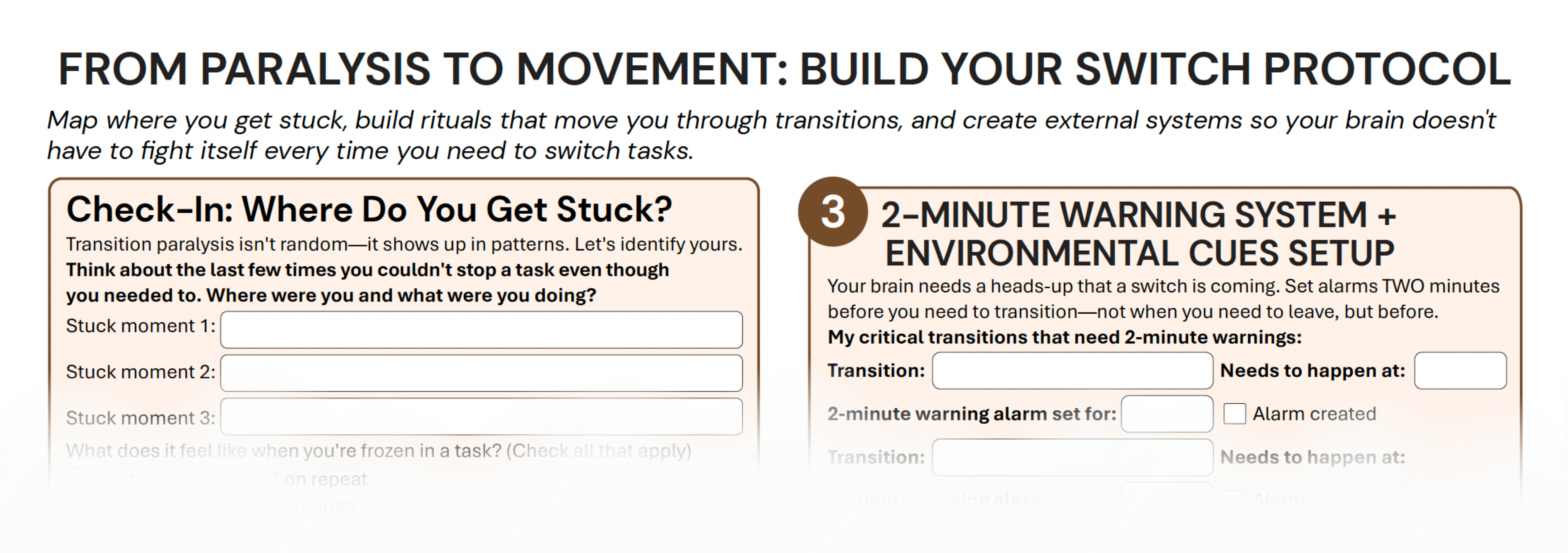
This week’s worksheet gives you a transition ritual builder for your five most common daily switches, a 2-minute warning system setup guide with specific alarm placement, environmental cue maps for your home and workspace, and a body-based transition menu you can reference when you’re frozen. It turns these strategies into external systems so your brain doesn’t have to generate them from scratch every time.
Fill it out in 5 minutes. Keep it where you transition most often. Watch the concrete start to crack.
Breaking free from the concrete
Now that you know your brain is physically incapable of switching tasks like others, let’s talk about what actually helps. These aren’t “just try harder” tips. They’re external scaffolding for a brain that won’t cooperate when you need it to.
The 2-minute warning system: Set an alarm for two minutes before you need to transition. This isn’t your “leave now” alarm. It’s your brain’s heads-up that a switch is coming. Two minutes gives your prefrontal cortex time to begin the inhibition process.
