

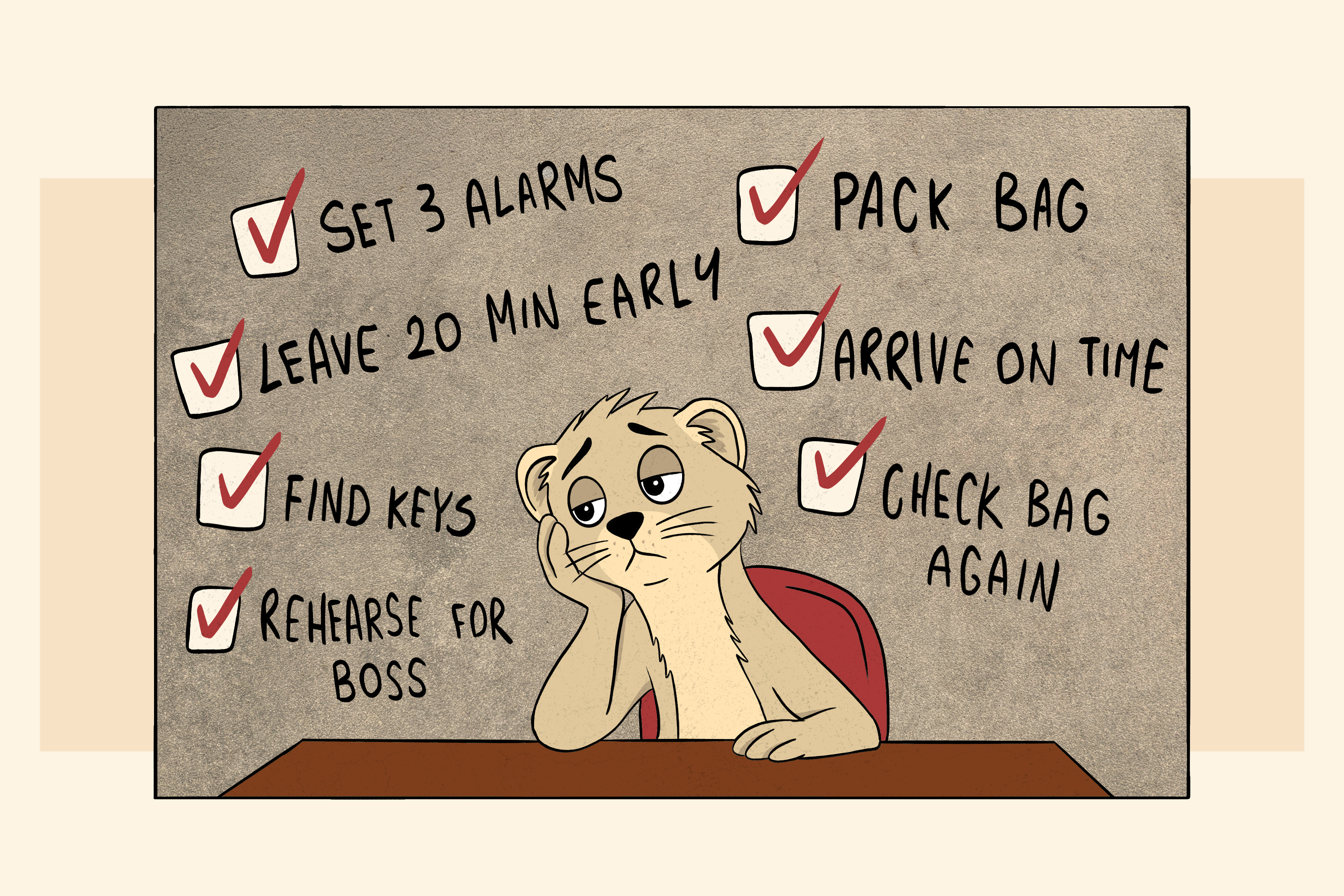
You woke up 40 minutes early so you’d have time to find your keys, check that you packed everything twice, and rehearse the thing you need to say to your boss. You left 20 minutes of buffer for traffic even though the drive takes 12. You set three alarms because you know you’ll dismiss the first two without remembering.
You got to work on time. Nobody clapped.
At the end of this newsletter, there’s a 5-minute worksheet called Your Invisible Workload, that helps you see the compensation work hiding behind your visible tasks and find one place to lighten the load.
The work before the work
Every task on your to-do list has a shadow list underneath it. The visible task is “attend the 10am meeting.” The invisible one is: remember the meeting exists, check the time twice, gather the notes you prepared last night because you knew you wouldn’t have the bandwidth this morning, leave early so you’re not late, rehearse your update in the car so you don’t freeze when it’s your turn.
Neurotypical brains handle most of this on autopilot. Ours don’t.
Our brains use more neural resources to achieve the same results as neurotypical brains. When adults with ADHD perform a task at the same level as someone without ADHD, we recruit additional brain regions to get there. More areas working harder, burning more fuel, for the same output. The result looks identical. The effort behind it is not.
And it starts before the task itself. Our ability to remember to do something in the future is impaired in ADHD. That’s why you set three alarms. That’s why you check your bag twice. Our working memory, the system that keeps information active while you use it, is compromised on both ends: the part that stores it and the part that rehearses it.
Remembering to remember is a full-time job our brains were never built for.
So we build scaffolding. Lists, reminders, sticky notes, phone alerts, asking a partner to remind us, putting things by the door, sending ourselves emails. Each piece of scaffolding is a compensation strategy. Every one is a manual task that costs energy.

The deep, bone-level exhaustion that comes from running your brain at full effort just to do the things other people do without thinking. 62% of adults with ADHD meet the threshold for clinical fatigue.
(We explored what happens when that exhaustion builds past the breaking point in You’re Not Lazy, You’re Empty.)
The better you get at compensating, the less anyone believes you’re struggling. (Including yourself.)
From our readers
“I have felt seen through your posts and felt like there was a way I could figure out how to make life work for me through your extensive research.. it gave me some hope.”
- Tanvi, paid subscriber
Things to try
Each strategy is tagged by energy level: 🥄 low, 🥄🥄 medium, 🥄🥄🥄 high. Pick the one that matches your brain today.
