

We’re kicking off something new today. Every so often, we’ll be featuring trusted ADHD experts to help you better understand ADHD: what the science says, where we struggle, and what can actually help. And we couldn’t think of a better person to start with than Dr. James Brown.
Dr. James Brown is a biomedical scientist, ADHD coach, and co-founder of the UK charity ADHDadultUK. He’s also the author of ADHD Unpacked and co-host of The ADHD Adults Podcast, a show known for mixing science with sarcasm to make ADHD actually make sense.
Diagnosed as an adult, James has become one of the UK’s most trusted educators on ADHD, known for translating complex science into clear, honest, and actually useful insight. Whether through his podcast, writing, or coaching, his work consistently helps people understand ADHD in a way that feels both validating and actionable.
This piece is no exception. It’s a practical, eye-opening deep dive into one of the most frustrating parts of ADHD: why getting started can feel impossible. James unpacks what’s really going on in the brain, especially around dopamine and motivation, and shares five research-backed strategies that can actually help.
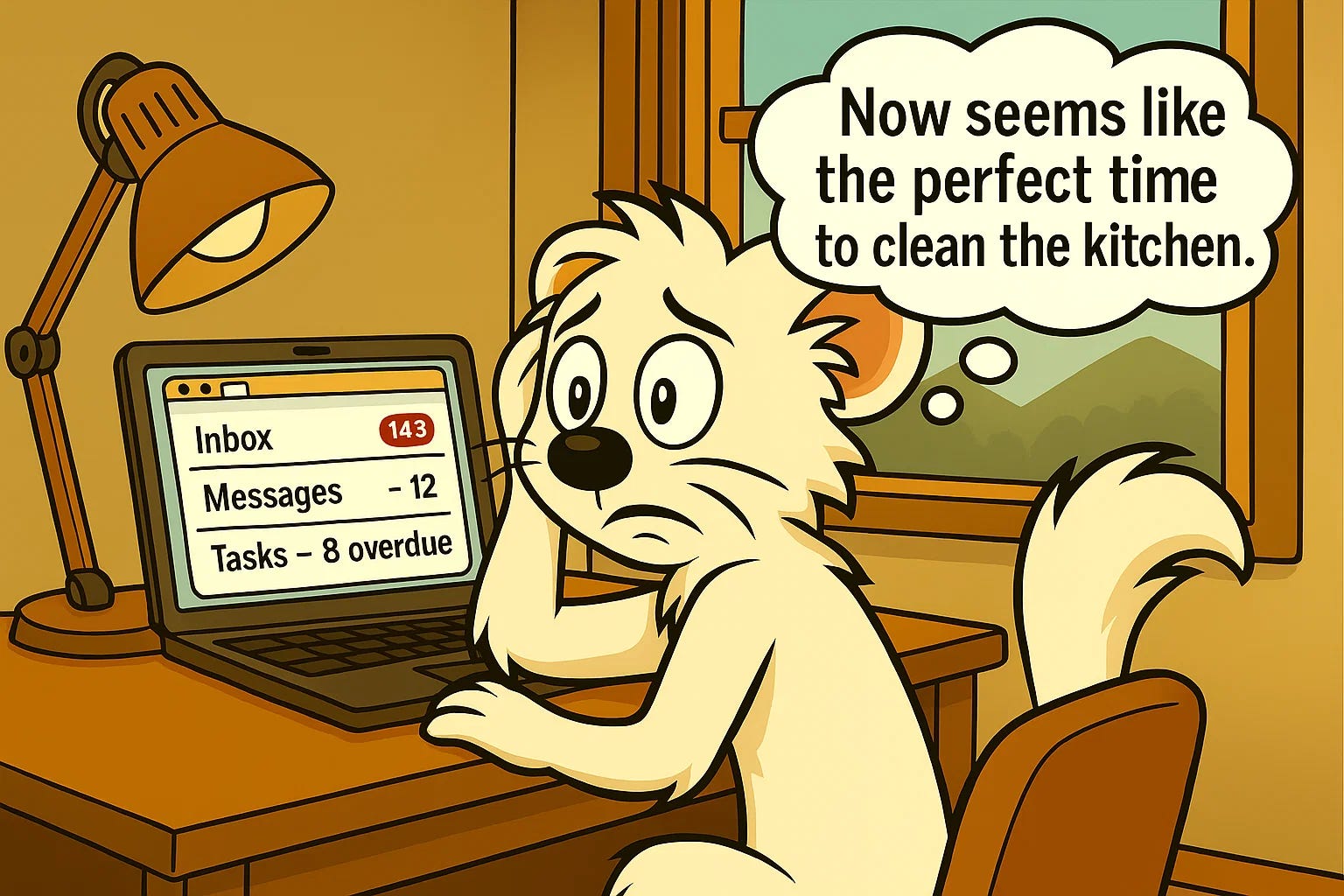
Ever stared at a to-do list, willing yourself to begin, and then decided, against all odds, that cleaning the kitchen was urgent? Welcome. I have many times sat staring at a computer screen, willing myself to start answering emails only to eventually promise myself, “Don’t worry, I’ll do it later”.
While in academia, I could routinely answer 150-200 emails a day, and it took me a long time to work out why this is no longer the case. As an academic, I had a motivation: fear. That unhealthy motivation may have driven me to answer emails in a timelier fashion, but it came at a cost to my mental health.
Dopamine: More Than Just a Buzzword
Thanks to social media, dopamine’s reputation swings between miracle cure and convenient scapegoat. But while dopamine isn’t the sole cause of ADHD symptoms, it is an integral part of the puzzle, particularly when it comes to motivation.
Let’s bust a couple of myths.
First, it’s not that people with ADHD don’t have dopamine, it’s that our brains don’t use it efficiently. Dopamine tends to get transported away from its specific dopamine receptors too quickly to have its full effect.
Second, it’s not the “pleasure chemical.” Dopamine isn’t just about feeling good; it’s about wanting, learning, and taking action. It’s the brain chemical that nudges us to ask, “Is this worth the effort?” and then (hopefully) answers, “Yes, go!”
Think of it as your brain’s internal project manager, directing your energy and attention. When it’s working, it helps you get started and stay on track, whether that’s writing a report, making a sandwich, or hyperfocusing on a new idea at 2 am.
Dopamine and Reward: The Anticipation Game
Dopamine plays a key role in the brain’s reward system, particularly in anticipation. It’s that expectation of a reward that kicks off motivation. When your brain expects a positive outcome, dopamine is released to get you moving toward it.
However, in ADHD, that reward signal often fails to materialize. The things that motivate other people, such as completing a spreadsheet or responding to emails, might not generate enough of a dopamine response to get our brains going. That’s why we gravitate towards activities that provide an immediate, predictable boost: social media, gaming, snacks, or even completely unrelated tasks.
In my work as an ADHD Coach, I’ve seen people cry from shame over not having the motivation to tidy a laundry pile while holding down a high-pressure job as a doctor. Motivation gaps aren’t about capacity, they’re about chemistry. ADHD brains self-regulate using whatever tools give it enough dopamine to function.
Here’s one way to think about it: if someone offered you a slice of pie now or a whole pie next week, which would you choose? Many people would go for the slice; immediate gratification is powerful. However, for brains with ADHD, the drive for the ‘now’ over the future is even stronger.
Motivation: Why Can’t I Just… Start?
Because dopamine and reward are so tightly linked to motivation, this disconnect has real consequences. Without a sufficient dopamine signal, starting a task can feel like pushing through a mental brick wall. It’s not procrastination in the typical sense. It’s also not as simple as ‘demand avoidance’. It’s an eerie mental blankness where no spark means no start.
Interestingly, we’re often not unmotivated; we’re just inconsistently motivated. Something genuinely interesting, urgent, or stressful can suddenly switch us on. The dopamine flows, and the task gets done. But for dull, repetitive, or complex jobs? Motivation is often nowhere to be found.
ADHD brains often rely on external motivation, things like deadlines, pressure, or accountability, because internal motivation (the ability to self-start and self-sustain) can be unreliable.
And yet, when motivation doesn’t show up, we’re still often met with judgment. “Try harder.” “Use more willpower.” But let’s be clear: ADHD-related motivation struggles are neurological, not moral. Struggling to get started isn’t a personality flaw, in the same way that having impaired vision isn’t a failure to ‘look harder’.
So… What Actually Helps?
There’s no universal fix as ADHD brains are wildly diverse. But here are some approaches that many people find useful:
Body Doubling (External Accountability)
This technique involves working in the presence of another person, either physically or virtually. The other person doesn’t have to do the same task or even interact with you during the task. Their presence alone can act as a kind of accountability anchor, helping trigger the start of a task and maintain focus. I run body doubling sessions every morning at 9:00 a.m., and they can be transformational. As the session organizer, I use the time to tackle those emails, and those who attend use the time to try to accomplish whatever task eludes them the most, whether it’s self-care, planning the day or starting that ‘unstartable’ task.
Gamification
Turning tasks into games using points, streaks, badges, or progress bars can trick the brain into engaging in less stimulating activities. You can compete with yourself or invite others into the mix for added pressure. Just be mindful: poorly designed gamification can backfire if rewards feel controlling or lead to a sense of ‘losing’.
